
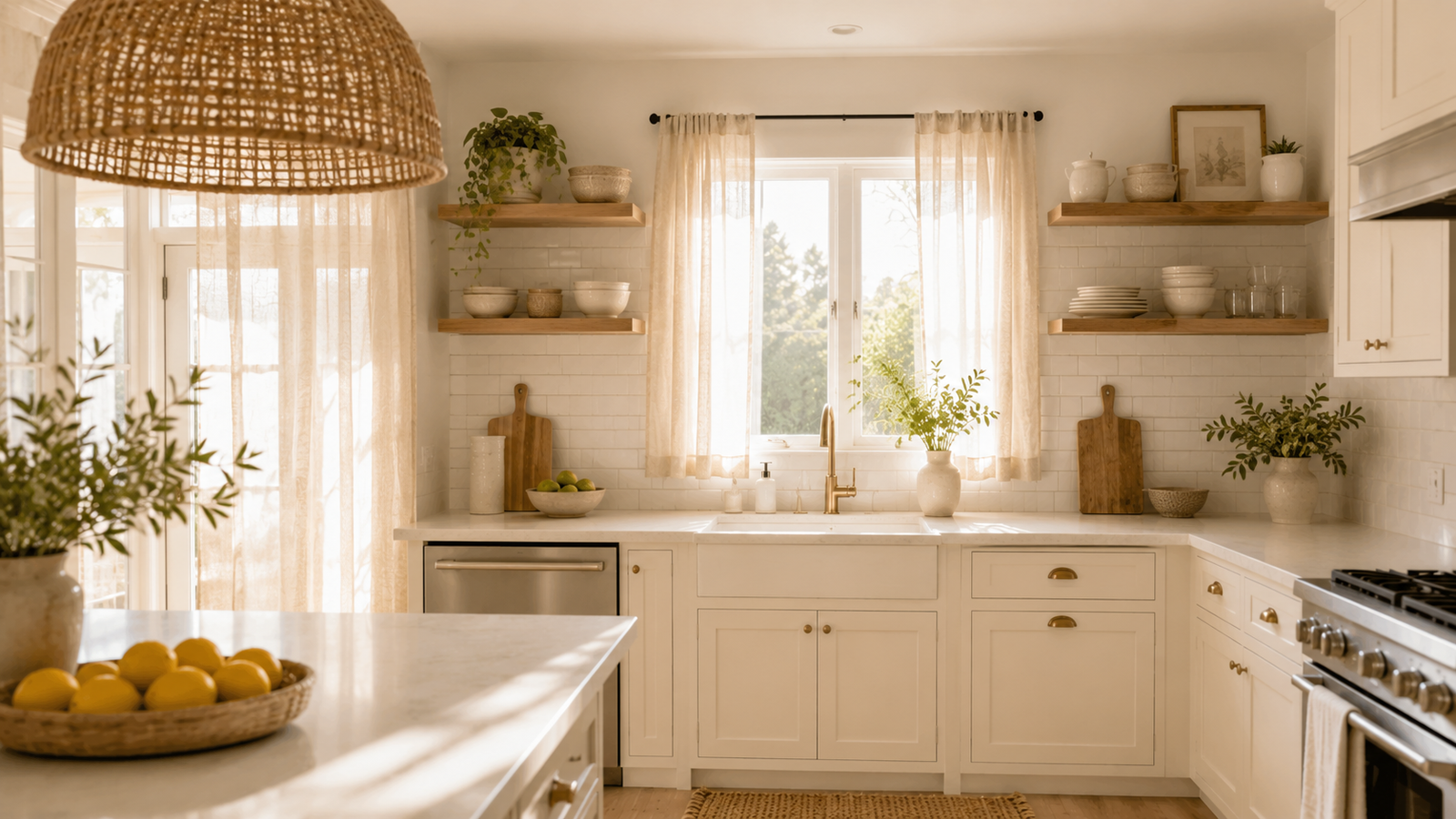
The first time I understood what a “coastal kitchen” actually meant, I wasn’t anywhere near a beach. I was standing in my sister’s rental in a landlocked town three hours from the nearest coastline, and somehow her kitchen made me feel like I needed to go put my feet in sand. There was no ocean view, no salt in the air, nothing dramatic about the location at all. It was just white walls, a woven light fixture, blue-and-white striped towels, and light pouring in through sheer curtains. I remember asking her, half-joking, “did you hire someone to make your kitchen feel like a vacation?” She laughed and told me she’d spent maybe $300 total, most of it on paint and a few thrifted finds.
That conversation stuck with me for years, and when I finally redid my own kitchen, coastal was the direction I kept coming back to. Not because I live near water either, but because it’s one of the few design styles that genuinely changes how a room feels to stand in, not just how it looks in a photo. Here’s everything I learned about building that feeling on purpose, room by room, decision by decision.
What “Coastal” Actually Means (Beyond Anchors and Seashells)
A lot of people hear “coastal kitchen” and picture something a little dated — rope-wrapped mirrors, a bowl of seashells nobody asked for, maybe a wooden sign that says “Beach House Rules.” That version of coastal design had its moment, but it’s not really what makes a kitchen feel breezy anymore.
Real coastal design in 2026 is quieter than that. It leans on light, texture, and a restrained color palette more than literal ocean symbols. Think of it less as “beach house decor” and more as “the feeling of a window open on a mild day.” That distinction matters, because it means you don’t need to live anywhere near the ocean, and you definitely don’t need actual seashells, to pull it off convincingly.
Start With Light, Because Everything Else Depends on It
Before I touched paint or furniture, I spent a weekend just paying attention to how light moved through my kitchen. Coastal design lives and dies on natural light, so the first real decision isn’t a color swatch, it’s whether your window treatments are helping or fighting you.
I replaced heavy curtains with simple linen ones that let light diffuse through softly instead of blocking it or letting in harsh direct sun. That single change did more to set the coastal mood than almost anything I bought afterward. If your kitchen is naturally dim, consider this the one area worth spending a little more on, because it’s the foundation everything else sits on top of.
Choosing a Color Palette That Doesn’t Feel Like a Costume
The instinct with coastal design is to reach for navy and bright turquoise, but I’d actually steer you away from going too literal. My kitchen ended up in a palette of warm white, soft driftwood grey, and a muted seafoam that only shows up in small doses, on a runner rug and a few pieces of pottery.
The trick is restraint. One dominant neutral, one soft secondary tone, and one small accent color used sparingly reads as coastal. Four different shades of blue scattered everywhere reads as themed, in a way that starts to feel more like a costume than a design choice. If you’ve already read through ideas for green cabinet tones, the same logic about restraint and undertone applies here just as much.
Natural Materials Do More Work Than Any Accessory
If there’s one thing I’d tell someone starting from scratch, it’s this: buy fewer decorative objects and spend that money on natural materials instead. Woven baskets for storage, a rattan pendant light, wooden cutting boards left out on the counter instead of hidden in a drawer — these do more to build the coastal feeling than any amount of nautical-themed decor ever will.
I found a woven light fixture secondhand for $25 and it became the single most-complimented thing in my kitchen. Texture, in this style especially, carries more visual weight than color does.
Open Shelving Fits This Style Almost Perfectly
Coastal kitchens tend to favor a slightly undone, lived-in look over a fully closed, matched-cabinet look, which makes open shelving a natural fit here in a way it isn’t for every style. I moved my everyday dishware, a stack of linen napkins, and a small collection of light-colored pottery onto two floating shelves, and it gave the whole wall a relaxed, breathing quality that closed cabinets just can’t replicate. If you’re on the fence about how much shelving to commit to, it’s worth reading a full breakdown of what open shelving involves day to day before pulling anything off the wall.
Backsplash Choices That Support the Mood Instead of Competing With It
I almost made the mistake of choosing a busy patterned tile because it looked striking on its own in a store display. In the actual kitchen, it fought with everything else in the room. I went with a simple white subway tile instead, laid in a classic horizontal pattern, and it let the woven textures and natural materials be the visual interest instead of competing with them.
If your kitchen already leans warm and textural, a quiet backsplash almost always outperforms a bold one. Save the boldness for something you can change easily later, like a runner or a set of towels.
Small Details That Finish the Look
A bowl of lemons on the counter, a linen tea towel draped over the oven handle, an unfussy vase with a single stem of eucalyptus — none of these cost more than a few dollars, and together they do more finishing work than a single expensive centerpiece would. This is where the “breezy” part of coastal design really comes alive, in the small, slightly imperfect touches rather than anything matched or staged too perfectly.
Where I’d Slow Down If I Did It Again
I bought a set of blue-and-white striped dish towels early on, thinking they’d be a safe coastal staple, and they ended up being the one thing in the kitchen that felt a little too on-the-nose next to everything else I’d chosen more carefully. I’d tell past-me to wait, live in the space for a few weeks, and let the smaller accent choices come more slowly instead of buying them all in the first week out of excitement.
Key Takeaways
- Coastal kitchen design in 2026 leans on light, texture, and restraint rather than literal ocean symbols like anchors or seashells.
- Natural light and simple window treatments are the foundation the rest of the style depends on.
- A limited, muted color palette reads as intentional; too many bright blues in one room reads as themed.
- Natural materials like rattan, wood, and woven baskets carry more of the coastal feeling than decorative accessories do.
- Small, slightly imperfect finishing touches often do more than one expensive statement piece.
Frequently Asked Questions
Do I need to live near the ocean for a coastal kitchen to make sense? Not at all. Coastal design is really about light, texture, and a calm color palette, and it works just as well in a landlocked home as it does near the water.
What colors work best for a coastal kitchen that doesn’t feel dated? Warm whites, soft greys, and one muted accent color used sparingly tend to feel current, while heavy navy paired with bright turquoise can start to feel more like a themed room than a designed one.
Is open shelving necessary for a coastal look? No, but it fits especially well with this style because coastal design tends to favor a slightly relaxed, lived-in feel over a fully closed, matched-cabinet look.
What’s the most budget-friendly way to start a coastal kitchen update? Window treatments and small natural-material accessories, like a woven light fixture or wooden cutting boards left out, offer the most visual impact for the least money.
Should I avoid nautical decor entirely? Not entirely, but use it sparingly. One or two subtle natural or nautical-adjacent touches read as intentional; a room full of anchors and rope details tends to feel more like a costume than a style.
You may also like:
- 15 Latest Green Kitchen Cabinet Ideas
- 10 Small Kitchen Wall Decor Ideas
- Budget-Friendly Kitchen Makeover Ideas Under $500
- 15 Modern Australian Kitchen Design Ideas
Editorial Disclaimer
This article reflects personal experience and general home styling suggestions and is intended for informational and inspirational purposes only. Results can vary depending on your kitchen’s layout, lighting, and existing materials. Always consult a licensed contractor before undertaking structural or electrical work. This page may display advertisements, including through Google AdSense; PrimeBuzzHub does not receive compensation from any specific brand or product mentioned above unless otherwise disclosed.