
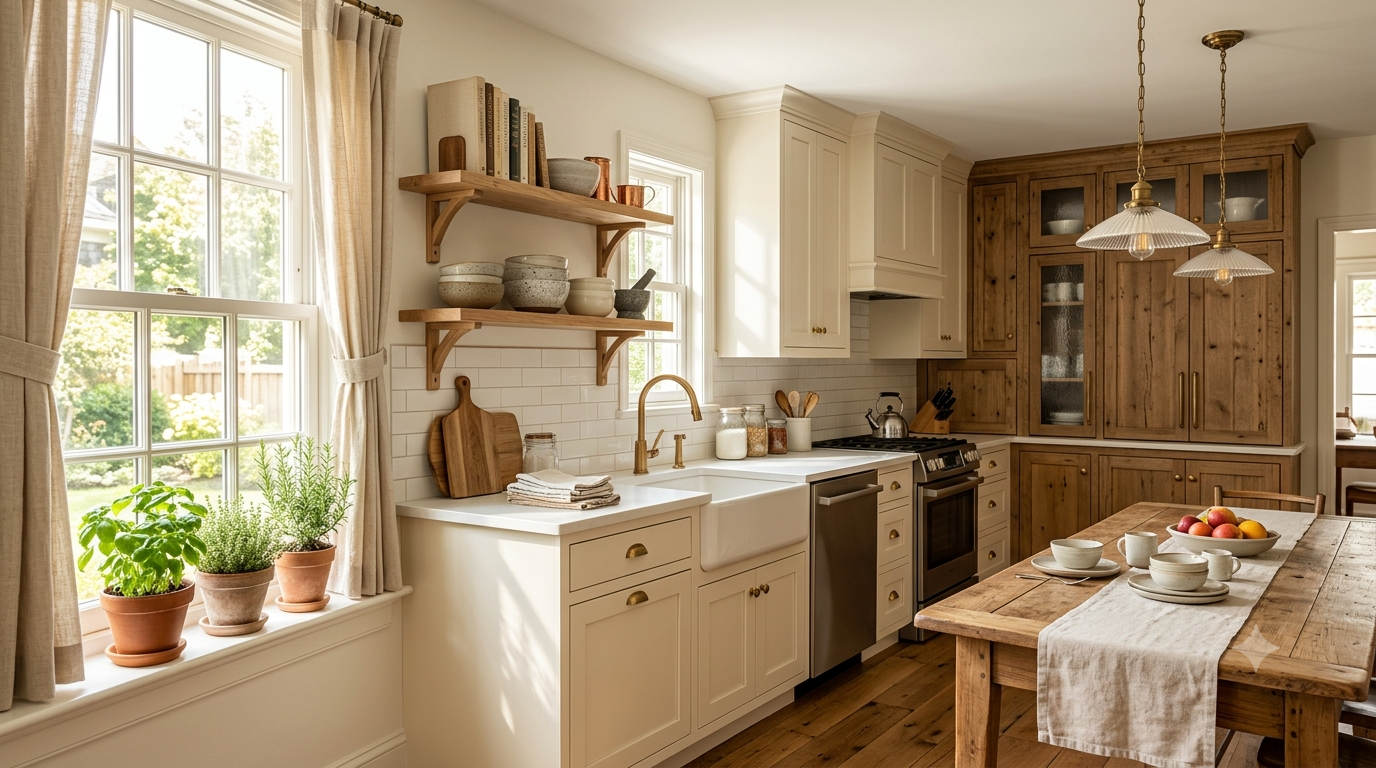
I Fell in Love With a 70-Year-Old Cabinet—But It Looked Completely Out of Place
When we began renovating our kitchen, I had a very clear picture in my mind of what it would become. I imagined clean white cabinetry, slim brass handles, bright quartz countertops, and enough natural light to make the room feel open from morning until evening. Everything was carefully planned, and for a while, I thought I wanted a kitchen that looked completely modern.
Then, quite unexpectedly, I came across an old wooden cabinet at a neighborhood antique market.
Its oak surface had softened over decades of use. The corners were gently worn, the brass latch carried the kind of patina you simply can’t manufacture, and every tiny mark seemed to tell a story. I wasn’t looking for antique furniture that day, but I couldn’t stop thinking about it. A week later, I drove back and brought it home.
The excitement lasted until I placed it against the kitchen wall.
Instead of creating the warm, inviting atmosphere I had imagined, it looked like it belonged in someone else’s house. The cabinet itself was beautiful. The kitchen was beautiful. Yet together, they seemed to be speaking completely different design languages.
For a brief moment, I considered selling it.
Fortunately, I didn’t.
Over the following weeks, I began studying kitchens that successfully blended vintage character with modern simplicity. I visited cafés, boutique hotels, and beautifully restored homes. I paid attention not just to the furniture but to how every material, color, and texture worked together.
Slowly, I realized something important.
Creating a vintage-modern kitchen isn’t about combining old things with new things.
It’s about creating a conversation between them.
Once I understood that, the entire room began to transform.
The Secret Isn’t Balance—It’s Respect
People often say the secret to mixing design styles is finding the right balance.
While that’s partly true, I think there’s something even more important.
Both styles need to respect each other.
If every modern surface is glossy, perfectly smooth, and highly polished while every vintage piece is heavily distressed and ornate, the room starts to feel like two different kitchens forced into one space.
The kitchens that truly feel timeless allow each style to complement the other rather than compete for attention.
That usually means letting one style lead while the other quietly adds depth and personality.
In my own kitchen, the architecture remained modern. The cabinetry stayed simple, the countertops uncluttered, and the lighting clean and understated. Vintage elements entered gradually through furniture, handcrafted ceramics, aged wood, and carefully chosen accessories.
Instead of fighting the contemporary design, those older pieces softened it.
The room immediately felt warmer, calmer, and far more welcoming.
Begin With a Modern Foundation
One mistake I nearly made was trying to recreate an old farmhouse kitchen from scratch.
The problem was that my house wasn’t old.
Its large windows, open floor plan, and minimalist architecture naturally suited a contemporary interior.
Trying to force historical details into that setting would have felt artificial.
Instead, I discovered that the most successful vintage-modern kitchens almost always begin with a clean, functional layout.
Simple shaker cabinets.
Neutral walls.
Quality countertops.
Practical storage.
Modern appliances.
This contemporary foundation allows vintage pieces to stand out naturally without overwhelming the room.
Think of it like wearing a classic white shirt with a beautiful vintage watch.
The simplicity of one makes the other even more noticeable.
Let Natural Materials Tell the Story
One of the biggest differences between older kitchens and many modern ones is the presence of natural materials.
Older homes embraced solid timber, handmade ceramics, aged metals, linen fabrics, and natural stone because those were the materials available.
Today’s kitchens sometimes rely so heavily on manufactured finishes that they risk feeling a little too perfect.
Adding authentic natural textures immediately changes that atmosphere.
In our kitchen, a reclaimed oak shelf replaced floating laminate shelving.
Suddenly, everyday objects like coffee mugs and cookbooks looked more intentional.
A handcrafted ceramic fruit bowl brought subtle imperfections that made the room feel lived in.
Even replacing synthetic bar stools with wooden ones introduced warmth that no paint color could achieve.
Natural materials age gracefully.
Instead of looking worn out, they often become even more beautiful with everyday use.
That’s exactly why vintage and modern design work so well together—they both celebrate simplicity, just in different ways.
Don’t Try to Make Everything Vintage
After discovering antique markets, I briefly became a little too enthusiastic.
One vintage chair became two.
Then an old wall clock.
A collection of enamel containers.
A copper kettle.
Several framed botanical prints.
Before long, the kitchen started looking less like a thoughtfully designed home and more like a small antique shop.
That experience taught me an important lesson.
Vintage pieces become special because they’re selective.
When every object tries to tell a story, none of them truly stand out.
Today, I prefer choosing only a handful of meaningful pieces.
Perhaps an antique pantry cabinet.
A reclaimed dining table.
A set of handmade wooden cutting boards.
Maybe an old brass pendant light above the island.
Giving those items room to breathe allows them to become natural focal points instead of visual clutter.
Ironically, using fewer vintage pieces often creates a stronger vintage atmosphere.
Color Is What Quietly Connects Everything
One thing I hadn’t fully appreciated before this project was how much color influences our perception of different styles.
The antique cabinet that originally looked completely out of place didn’t actually have a design problem.
It had a color problem.
Its warm honey-toned wood felt disconnected from the cool gray walls and bright white cabinetry surrounding it.
Rather than replacing the cabinet, I adjusted the rest of the palette.
The walls became a warmer off-white.
The backsplash introduced soft beige undertones.
Linen curtains replaced crisp white blinds.
Almost overnight, the cabinet looked as though it had always belonged there.
That experience completely changed how I approach interior design.
Before replacing furniture, look at the colors surrounding it.
Often, harmony comes not from buying something new but from helping existing pieces speak the same visual language.
Modern Appliances Don’t Need to Be Hidden
One question I hear surprisingly often is whether modern appliances ruin the vintage look.
I don’t think they do.
In fact, pretending technology doesn’t exist usually feels less authentic than simply allowing it to coexist with older elements.
Our induction cooktop sits beside a reclaimed wooden shelf.
The stainless-steel oven is framed by traditional shaker cabinetry.
The refrigerator is modern, but it’s softened by nearby open shelving filled with pottery and cookbooks.
Rather than hiding every contemporary appliance, I found it far more effective to surround them with warmth.
That contrast reminds us that this is a kitchen built for today’s life while still appreciating yesterday’s craftsmanship.
Lighting Is What Brings the Two Worlds Together
If there’s one element that quietly transformed the entire space, it was the lighting.
When I first introduced vintage furniture into the kitchen, the room still felt disconnected. The antique pieces had warmth and character, but the cool, bright ceiling lights made everything feel flat. They highlighted the modern finishes while leaving the older materials looking almost forgotten.
Replacing those lights completely changed the atmosphere.
I chose warm LED bulbs with a soft color temperature, installed a pair of aged brass pendant lights above the island, and added subtle under-cabinet lighting that gently illuminated the backsplash in the evenings. During the day, sunlight highlighted the grain of the reclaimed wood, while at night, the warm lighting brought out the rich tones of the brass hardware and handmade ceramics.
Good lighting doesn’t simply help you see a room—it changes how the room feels. In a vintage-modern kitchen, it becomes the bridge between old craftsmanship and contemporary design.
Mixing Metals Isn’t a Mistake—If You Do It Intentionally
For years, I believed every metal finish in a kitchen had to match perfectly.
If the faucet was stainless steel, surely every handle, light fixture, and appliance had to follow the same rule.
It turns out the opposite is often true.
Some of the most inviting kitchens intentionally mix finishes to create depth and authenticity.
Brushed brass cabinet handles can sit comfortably beside a matte black faucet. An antique copper kettle can become a beautiful accent in a kitchen filled with stainless-steel appliances. Wrought iron shelf brackets introduce character without making the room feel overly rustic.
The trick is repetition.
Rather than introducing five different finishes randomly, repeat each material at least a few times throughout the room. That repetition creates rhythm, making the combinations feel deliberate rather than accidental.
Once I stopped worrying about perfect matching, the kitchen immediately felt more relaxed and lived-in.
Open Shelving Works Best When It Tells a Story
Open shelves have become one of the defining features of many modern kitchens, but they also offer the perfect opportunity to introduce vintage personality.
Instead of treating shelves as extra storage, I started thinking of them as a carefully curated display.
A stack of well-loved cookbooks.
A handmade ceramic pitcher collected while traveling.
An old wooden rolling pin that once belonged to a family member.
A few stoneware bowls used almost every day.
These weren’t expensive decorative purchases.
Most already belonged to our family.
Together, they quietly told the story of how the kitchen was actually used.
The biggest lesson I learned was resisting the urge to fill every inch of shelf space. Empty space allows beautiful objects to stand out, making the entire room feel calmer and more intentional.
Vintage Doesn’t Mean Dark
One misconception I had before beginning this project was that vintage interiors needed deep wood tones and darker colors.
While that certainly works in some homes, it isn’t the only interpretation.
Some of the most beautiful vintage-modern kitchens I’ve visited feel remarkably bright.
Cream-colored walls.
Soft sage cabinetry.
Natural oak shelving.
White linen curtains.
Large windows filled with morning light.
These lighter palettes preserve the airy feeling of a contemporary kitchen while allowing older furniture and accessories to provide warmth instead of heaviness.
If your kitchen is on the smaller side, keeping the overall palette light will help the room feel spacious while still embracing vintage charm.
Resist the Urge to Decorate Every Corner
There was a stage during our renovation when I felt every empty surface needed something.
Another basket.
Another framed print.
Another decorative bowl.
Every trip to a flea market ended with one more “perfect” find.
Eventually, I stepped back and realized something surprising.
The room no longer felt peaceful.
It felt crowded.
That’s when I understood one of the defining characteristics of good design: confidence.
Confident spaces don’t try to impress with quantity.
They rely on a handful of meaningful pieces that have room to breathe.
Today, the kitchen contains far fewer decorative items than it once did, yet every object feels more significant because it has been chosen carefully.
The result is a room that feels collected over time rather than decorated all at once.
The Best Vintage Pieces Usually Have a Story
Interestingly, my favorite item in the kitchen isn’t the most valuable one.
It’s an old wooden stool that belonged to my grandparents.
Its paint has faded, the edges are softened from years of use, and it would probably never appear in a luxury furniture showroom.
Yet it’s the first thing visitors ask about.
Not because it’s perfect, but because it feels authentic.
That’s something I’ve come to appreciate about vintage design.
Objects with genuine history create emotional warmth that brand-new accessories often struggle to replicate.
Whether it’s a family heirloom, a flea market discovery, or a handcrafted piece from a local artisan, meaningful objects give a kitchen its personality.
Those are the details people remember long after they’ve forgotten the paint color or countertop material.
Why This Style Feels So Timeless
Design trends change constantly.
A color that’s everywhere today might feel dated in five years.
Cabinet styles evolve.
Hardware finishes come and go.
Yet vintage-modern kitchens continue to feel relevant because they’re not built around trends.
They’re built around contrast.
The clean efficiency of contemporary living meets the warmth and craftsmanship of older generations.
Modern appliances make cooking easier.
Vintage furniture reminds us that homes are meant to be lived in, not simply admired.
That balance gives the room a sense of permanence.
It doesn’t feel trapped in one particular decade.
Instead, it quietly borrows the best ideas from several.
Final Thoughts
Looking back, I’m grateful I didn’t sell that old cabinet.
What originally felt like a decorating mistake ended up teaching me one of the most valuable lessons I’ve learned about interior design.
Beautiful rooms aren’t created by buying everything from the same collection or following every trend that’s popular online.
They’re created gradually.
Through patience.
Through meaningful choices.
Through objects that carry memories as well as function.
Today, when I walk into the kitchen, I no longer notice where the vintage pieces end and the modern ones begin.
They simply belong together.
And perhaps that’s the real goal of good design.
Not to make people admire individual pieces, but to create a space that feels welcoming enough that nobody thinks about the design at all.
Instead, they simply enjoy being there.
Key Takeaways
- Start with a clean, modern foundation and introduce vintage elements gradually.
- Choose natural materials such as wood, stone, brass, and ceramics to create warmth.
- Limit vintage décor to a few meaningful pieces instead of overcrowding the room.
- Use warm lighting to unify contemporary and antique elements.
- Mix metal finishes intentionally by repeating them throughout the space.
- Keep the overall color palette soft and cohesive.
- Focus on creating a kitchen with personality rather than following short-term trends.
Frequently Asked Questions
What is a vintage-modern kitchen?
A vintage-modern kitchen combines contemporary layouts, appliances, and functionality with carefully selected vintage furniture, materials, or décor to create a timeless and welcoming space.
How do I mix vintage and modern without making the kitchen look cluttered?
Start with a modern foundation, introduce only a few vintage statement pieces, maintain a consistent color palette, and avoid filling every shelf or countertop with decorative items.
What colors work best for vintage-modern kitchens?
Warm whites, soft creams, sage green, greige, muted blues, natural oak, walnut, and earthy neutrals work beautifully because they complement both modern finishes and antique materials.
Can modern appliances work in a vintage-style kitchen?
Absolutely. Modern appliances provide convenience while vintage furniture and accessories soften their appearance, creating a balanced and practical kitchen.
Is vintage-modern design just a passing trend?
Not really. While individual colors and finishes may change, combining timeless craftsmanship with modern functionality has remained popular because it creates homes that feel personal rather than trend-driven.
Editorial Disclaimer
This article is intended for informational and inspirational purposes only. Design preferences, renovation costs, and material performance vary depending on your home, budget, and lifestyle. Recommendations reflect current interior design trends and practical experience rather than paid endorsements. PrimeBuzzHub may display advertisements from Google AdSense and other trusted advertising partners. Advertising does not influence our editorial opinions or recommendations.