
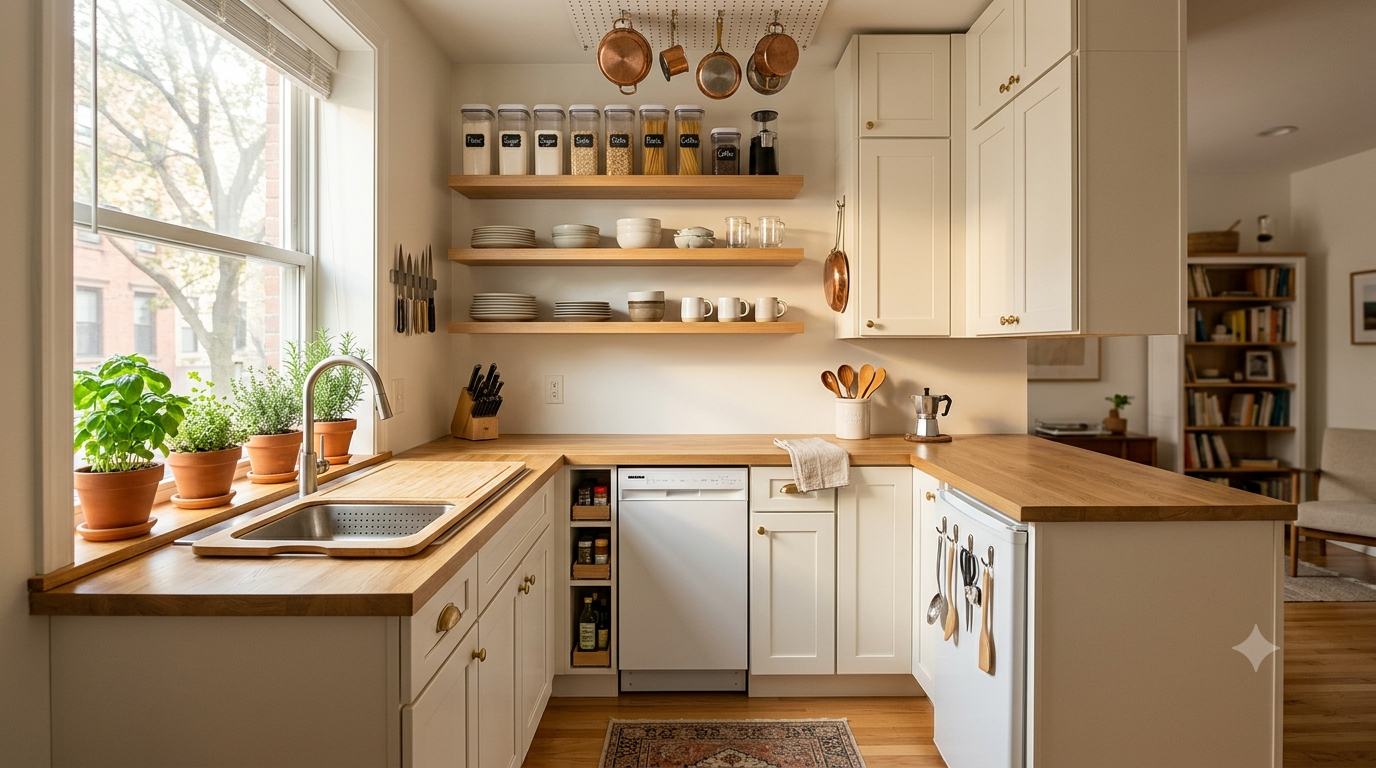
My First Apartment Had a Tiny Kitchen—and It Taught Me More Than Any Design Book
The first apartment I rented wasn’t much bigger than a hotel room.
At just under 400 square feet, every corner had to work hard. The kitchen was squeezed into one wall with barely enough counter space to chop vegetables, a handful of cabinets that filled up almost immediately, and a single drawer that somehow had to hold every utensil I owned.
At first, I thought I simply needed more storage.
So I bought baskets.
Then shelf risers.
Then stackable containers.
For a while, it helped.
But before long, the cabinets were overflowing again.
Opening one door often meant something would tumble onto the floor. Finding the right pan became a daily treasure hunt, and I spent far too much time moving things around just to prepare a simple meal.
It wasn’t until I stopped trying to fit more into the kitchen and started thinking about using the space differently that everything changed.
Little by little, I developed habits that made the kitchen feel bigger without adding a single square foot.
Looking back, living in that tiny apartment taught me more about organization than any perfectly designed showroom kitchen ever could.
If you’re working with limited space, these are the ideas that genuinely made everyday life easier.
Stop Thinking About Storage—Start Thinking About Accessibility
One mistake I made early on was trying to squeeze as much as possible into every cabinet.
Technically, I had more storage.
Practically, I couldn’t find anything.
Eventually, I realized the goal wasn’t fitting more items into the kitchen.
The goal was reaching everything easily.
That small shift completely changed how I organized the space.
Instead of stacking five mixing bowls together, I kept only the two I used every week.
Instead of storing rarely used gadgets in prime cabinet space, I moved them to a higher shelf outside the kitchen.
The result wasn’t an emptier kitchen.
It was a kitchen that worked better.
Vertical Space Is Your Best Friend
When floor space is limited, walls become incredibly valuable.
I installed a simple rail system above the countertop to hang cooking utensils, measuring cups, and oven mitts.
Suddenly, an overcrowded drawer became almost empty.
Open wall space also became home to magnetic knife strips, floating shelves for frequently used dishes, and small hooks for mugs.
Everything stayed within easy reach while freeing valuable cabinet space.
The kitchen felt larger because the countertops stayed clear.
That’s something I learned quickly:
A clean countertop instantly makes a small kitchen feel more spacious.
Every Cabinet Needs a Purpose
Before organizing, every cabinet in my apartment contained a random mix of cookware, food, mugs, and storage containers.
Finding anything meant opening several doors.
One weekend, I emptied everything onto the living room floor and started over.
One cabinet became dedicated to breakfast items.
Another stored cookware.
One shelf was reserved entirely for baking supplies.
Even the smallest drawer had a specific purpose.
Within a few days, I stopped searching for things because I always knew exactly where they belonged.
Organization isn’t about buying more containers.
It’s about creating predictable routines.
Drawer Organizers Are Worth Every Penny
The smallest upgrade made one of the biggest differences.
Instead of tossing utensils into a single drawer, I added a simple adjustable organizer.
Suddenly every item had a home.
Wooden spoons.
Whisks.
Measuring spoons.
Bottle openers.
Nothing shifted around anymore.
The drawer opened smoothly, and I could grab exactly what I needed without digging through a pile of metal utensils.
Sometimes the simplest improvements create the biggest daily convenience.
Think Like a Minimalist—Even If You’re Not One
I don’t consider myself a minimalist.
I enjoy cooking and genuinely use a variety of kitchen tools.
But living in a small apartment forced me to ask an important question before buying anything new:
“Where will this live?”
If I couldn’t answer that question immediately, I usually didn’t need the item.
That habit saved both money and space.
Over time, I realized I wasn’t sacrificing convenience.
I was avoiding clutter.
There’s a big difference.
A kitchen filled with useful tools feels productive.
A kitchen filled with duplicate gadgets quickly becomes frustrating.
Clear Containers Changed My Pantry Overnight
One of the biggest frustrations in my apartment was forgetting what I already had.
Half-open pasta packages.
Three bags of rice.
Spices hidden behind cereal boxes.
Everything disappeared into the back of the cabinet.
Switching to clear airtight containers completely changed that.
I could see exactly what needed refilling, ingredients stayed fresher, and the shelves looked far more organized.
As an unexpected bonus, meal planning became easier because I could quickly check what was available without pulling everything out.
Don’t Ignore the Space Above the Refrigerator
For the longest time, the top of my refrigerator became a dumping ground.
Old grocery bags.
Unused serving trays.
Random kitchen gadgets I hadn’t touched in months.
It looked cluttered, and every time I walked into the kitchen, it made the entire room feel smaller.
One afternoon, I cleared everything away and replaced the mess with two matching woven baskets.
One held extra paper towels and reusable shopping bags.
The other stored rarely used baking tools and seasonal kitchen items.
The change took less than thirty minutes, but suddenly that awkward space felt intentional instead of forgotten.
In a compact apartment, every vertical surface has potential—you just need to use it thoughtfully.
The Area Under the Sink Doesn’t Have to Be a Black Hole
If there was one cabinet I avoided opening, it was the one under the sink.
Cleaning sprays, sponges, garbage bags, dishwasher tablets, and random bottles somehow ended up in one tangled pile.
Finding anything meant moving everything else first.
Eventually, I added a small pull-out organizer and a couple of labeled bins.
One held cleaning cloths.
Another stored dishwashing supplies.
A narrow basket kept spare trash bags upright instead of crumpled in the back.
It wasn’t a dramatic makeover, but it turned one of the most frustrating areas in the kitchen into one of the easiest to use.
Sometimes organization isn’t about adding more storage.
It’s about making the storage you already have easier to access.
Foldable and Multi-Purpose Items Save More Space Than You Expect
Living in a 400-square-foot apartment quickly taught me that every item should earn its place.
Instead of buying gadgets designed for one specific task, I looked for products that could do several jobs.
A nesting mixing bowl set replaced several bulky bowls.
Collapsible colanders folded flat after use.
A cutting board designed to fit over the sink instantly created extra preparation space.
Even a small rolling cart became a portable pantry that doubled as a coffee station when guests visited.
These weren’t expensive upgrades.
They were simply smarter choices for a smaller home.
Make Your Countertops Work Harder by Keeping Them Simpler
I used to think countertops should display everything I used regularly.
The toaster.
The coffee machine.
Knife block.
Utensil holder.
Fruit bowl.
Spice rack.
Recipe books.
By the time I finished decorating, there was barely enough room left to prepare dinner.
Gradually, I removed anything I didn’t use every single day.
The difference was immediate.
Preparing meals became easier because I finally had space to work.
Ironically, the kitchen also looked cleaner and more stylish.
A mostly clear countertop creates a sense of calm that no decorative accessory can match.
Create Simple Habits Instead of Perfect Systems
One thing I learned after trying dozens of organization methods is that complicated systems rarely last.
Instead of aiming for perfection, I focused on small daily habits.
I washed dishes before going to bed instead of leaving them until morning.
I returned spices to the same shelf after cooking.
Every Sunday, I spent ten minutes checking the pantry and throwing away expired food.
Those tiny routines prevented clutter from building up in the first place.
The kitchen never stayed perfectly organized.
But it also never became overwhelming again.
Consistency mattered much more than perfection.
Let Your Kitchen Breathe
When space is limited, it’s tempting to fill every empty shelf.
I made that mistake more than once.
Every time I found an unused corner, I bought another organizer or another storage basket.
Eventually, I realized the empty spaces were actually helping the kitchen feel bigger.
Not every shelf needs to be full.
Not every wall needs another hook.
Leaving a little visual breathing room makes even the smallest apartment kitchen feel lighter and more comfortable.
Sometimes the smartest organization hack is knowing when to stop organizing.
Small Decorative Touches Still Matter
Just because a kitchen is compact doesn’t mean it has to feel purely functional.
Once everything was organized, I added a few simple details that made the space feel like home.
A small herb plant near the window.
A linen tea towel hanging beside the sink.
A ceramic bowl filled with lemons.
A wooden cutting board leaning against the backsplash.
None of these items took up much space, but together they made the kitchen feel warm, welcoming, and lived in.
Good organization creates room for personality.
What Living in 400 Square Feet Really Taught Me
Looking back, I don’t remember the apartment for how small it was.
I remember how resourceful it forced me to become.
That tiny kitchen taught me to buy more intentionally.
To appreciate quality over quantity.
To organize around daily habits instead of unrealistic expectations.
Ironically, when I eventually moved into a larger home, many of those habits stayed with me.
I still avoid overcrowding cabinets.
I still keep countertops as clear as possible.
And I still believe that a well-organized kitchen has much less to do with its size than with how thoughtfully it’s used.
A larger kitchen can feel chaotic.
A small kitchen can feel effortless.
The difference isn’t square footage.
It’s how you use every inch.
Final Thoughts
If you’re standing in a tiny apartment kitchen wondering how you’ll ever make it work, I completely understand.
I’ve been there.
I’ve struggled with overflowing cabinets, limited counter space, and drawers that refused to close.
But I’ve also learned that small kitchens have an unexpected advantage.
They encourage you to simplify.
To keep only what you truly use.
To create routines that save time every single day.
Those lessons don’t just improve your kitchen.
They make everyday life a little calmer.
And that’s something no amount of extra square footage can replace.
Key Takeaways
- Focus on accessibility, not simply adding more storage.
- Use vertical wall space with shelves, rails, and hooks.
- Assign a clear purpose to every cabinet and drawer.
- Keep countertops as open as possible for both function and visual space.
- Choose multi-purpose tools that replace several single-use gadgets.
- Organize under-sink storage with bins and pull-out organizers.
- Small daily habits are more effective than complicated organization systems.
Frequently Asked Questions
How do I organize a very small apartment kitchen?
Start by decluttering, assigning each cabinet a specific purpose, using vertical storage, and keeping only frequently used items within easy reach.
What is the biggest mistake people make in small kitchens?
Trying to store too much. Overfilled cabinets and cluttered countertops make even functional kitchens feel cramped.
Are open shelves a good idea for small apartments?
They can work well when used in moderation. Open shelves create visual openness but should be styled carefully to avoid looking cluttered.
How can I create more counter space?
Use over-the-sink cutting boards, store small appliances inside cabinets when possible, and remove decorative items that don’t serve a daily purpose.
What’s the easiest organization upgrade?
Drawer organizers, clear pantry containers, and under-cabinet hooks are inexpensive improvements that make everyday cooking much easier.
Editorial Disclaimer
This article is intended for informational and inspirational purposes only. Every home has different storage needs, layouts, and space limitations. Organization ideas should be adapted to suit your lifestyle and available space. PrimeBuzzHub may display advertisements from Google AdSense and other trusted advertising partners. Advertising does not influence our editorial recommendations or opinions.